
How America Is Quietly Profiting From Gulf Oil Chaos Amid Rising Tensions
Rising geopolitical tensions in the Gulf have once again shaken global energy markets, raising serious concerns over oil and liquefied natural gas (LNG) supply chains.
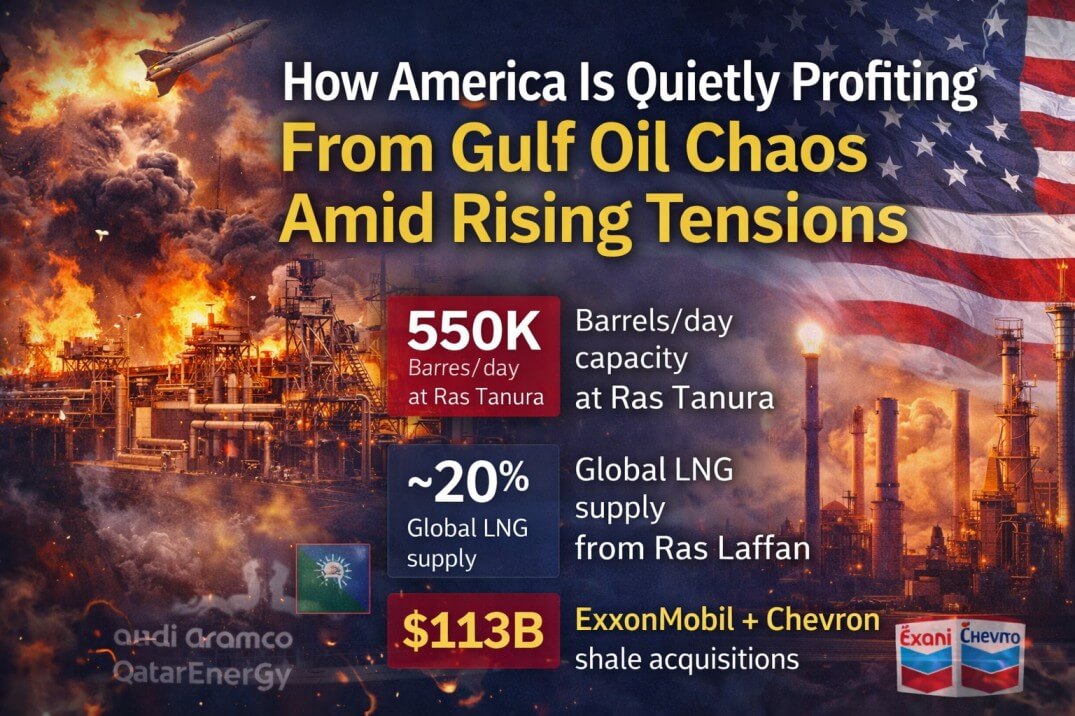
Reports indicate that Iranian missile strikes targeted Saudi Aramco’s Ras Tanura refinery — one of the kingdom’s key oil processing hubs with a capacity of approximately 550,000 barrels per day. Any disruption at Ras Tanura has immediate global implications given Saudi Arabia’s central role in global oil exports.
Simultaneously, QatarEnergy temporarily halted operations at its Ras Laffan LNG facility. The plant accounts for nearly 20% of global LNG supply, making it a critical node in international energy trade. The shutdown sent shockwaves across global energy markets, pushing prices higher.
Why the United States Could Benefit
While Gulf Cooperation Council (GCC) economies face uncertainty, the United States stands in a strategically advantageous position. As the world’s largest oil and gas producer, America has significantly expanded domestic production over the past decade, particularly through shale extraction.
In 2024, two of America’s largest energy giants made massive strategic acquisitions:
ExxonMobil acquired Pioneer Natural Resources in a deal worth approximately $60 billion.
Chevron acquired Hess Corporation for around $53 billion.
These deals, totaling roughly $113 billion, strengthened U.S. shale production capacity — particularly in the Permian Basin.
Interestingly, these acquisitions coincided with the expiration of the decades-old U.S.-Saudi petrodollar agreement in March 2024. While officials have not drawn direct links, analysts note that the timing reflects a strategic shift in global energy influence.
Global Impact
Disruptions in Saudi oil processing and Qatari LNG exports have triggered:
Higher crude oil prices
Increased LNG spot prices
Renewed inflation concerns in import-dependent economies
Volatility in global equity markets
For energy-importing countries like India and parts of Europe, rising prices could strain fiscal balances. However, U.S. energy exporters may benefit from increased demand and higher margins.
Strategic Realignment?
Experts suggest that prolonged instability in the Gulf could accelerate diversification away from Middle Eastern supply. In such a scenario, U.S. energy companies — backed by expanded shale production — may capture a larger share of global exports.
While Gulf nations grapple with infrastructure risks and geopolitical uncertainty, the United States appears positioned to strengthen its foothold in the global energy landscape.
The unfolding situation highlights how geopolitical crises often reshape economic power dynamics — sometimes benefiting players far from the epicenter of conflict.


