Rare Rogue Planet Discovered in Milky Way
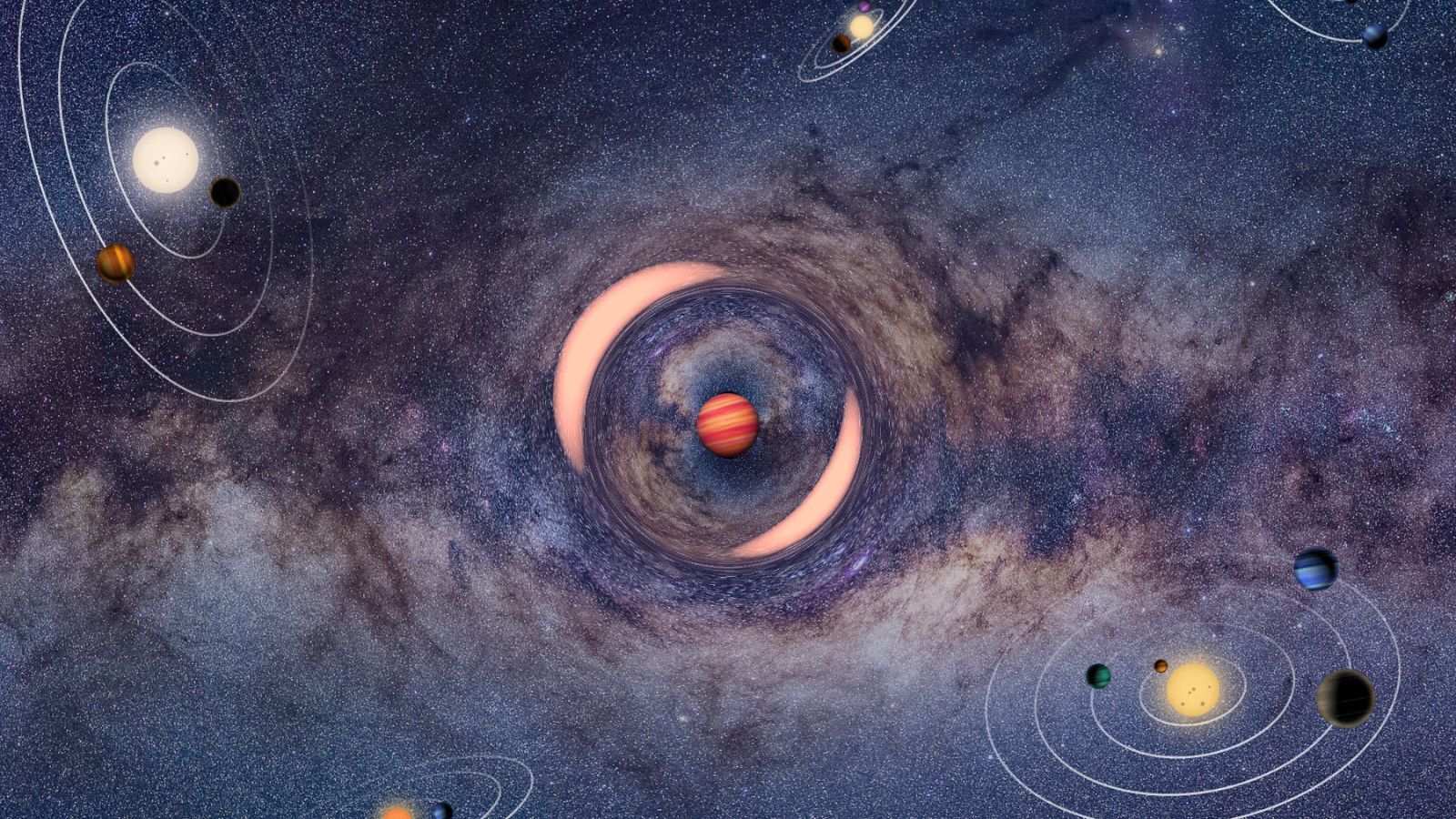
Astronomers have made a groundbreaking discovery that has captured the attention of the scientific community and the public alike. A rogue planet, approximately 10,000 light-years away from Earth, has been spotted drifting through the Milky Way without orbiting any star. This planet, comparable in size to Saturn, provides the clearest evidence of free-floating worlds that do not rely on a star for their existence.
Traditionally, planets are detected by observing their stars, but this newly identified rogue planet belongs to a more elusive category. While hints of rogue planets have been suggested in the past, confirming their existence has been challenging due to their faint luminosity. However, this discovery marks a significant advancement, as scientists successfully determined both the planet's distance and mass for the first time using advanced observational techniques.
The breakthrough occurred when astronomers noticed an unusual distortion in the light from a distant star in 2024. Multiple ground-based telescopes, along with the European Space Agency’s retired Gaia spacecraft, recorded a brief brightening of the star’s light. By analyzing this event from various perspectives, researchers concluded that the object responsible was a planet located approximately 9,950 light-years away, with a mass around 70 times that of Earth.
This finding strongly suggests that starless planets could be more prevalent than previously believed. Theoretical models indicate that gravitational interactions in the early stages of a planetary system can fling planets into interstellar space. Additionally, some scientists propose that certain rogue planets may form independently, collapsing from clouds of gas and dust, similar to how stars are born.
Detecting these wandering planets poses a significant challenge. They emit almost no visible light, prompting astronomers to employ the gravitational microlensing technique. This method allows scientists to observe the bending and magnification of a distant star’s light when a rogue planet passes in front of it, creating a distinct signal. Until now, determining the distance of these rogue worlds has been complicated, leading to the possibility of misidentifying them as failed stars known as brown dwarfs.
However, the recent microlensing event, observed from both Earth and space, enabled scientists to estimate the planet’s distance more accurately. This, in turn, facilitated mass calculations based on the duration of the light distortion. The researchers believe this adds to the growing evidence that many lonely planets may roam freely between the stars, and future observatories are expected to enhance the search for these elusive bodies.
Upcoming missions, such as NASA’s Nancy Grace Roman Space Telescope, set to launch in 2026, aim to survey vast regions of the galaxy at unprecedented speed. Similarly, China’s Earth 2.0 mission is also anticipated to seek out free-floating worlds later in the decade. The findings of this research, published in the journal Science, offer a glimpse into a hidden population of planets and reshape our understanding of planetary systems and their evolution.