
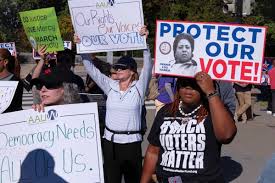
Supreme Court Challenges Voting Rights Act Provision
The US Supreme Court is currently weighing a pivotal decision that could reshape the Voting Rights Act, a cornerstone of civil rights legislation. The focus is on whether lawmakers can consider race when creating electoral maps. If the Court rules against this practice, the implications could be profound, particularly in states like Louisiana where the creation of majority-Black districts has been a contentious issue.
The case arises from a legal challenge to Louisiana’s electoral map, which was redrawn to include a second majority-Black congressional district. Critics argue that this change was necessary to ensure fair representation for Black voters. However, opponents contend that using race in this context constitutes unconstitutional racial gerrymandering.
During recent oral arguments, conservative justices expressed skepticism about the indefinite use of race in redistricting. Justice Brett Kavanaugh raised concerns about establishing a timeline for when race-based remedies should end. This reflects a broader trend in the Court's recent decisions, where there has been an increasing reluctance to endorse race-conscious policies.
The stakes are high, as a ruling against race-based mapping could lead to the elimination of several Democratic-held districts, particularly in the South. Such changes could significantly alter the political landscape leading up to the 2026 midterm elections, where minority representation in Congress could be at risk.
On the other hand, the liberal justices voiced concerns that removing race from the equation could dilute minority voting power, leading to what Justice Elena Kagan described as potentially catastrophic results. The Voting Rights Act was enacted to combat historical discrimination, and its provisions have been essential in ensuring that minority voices are heard in the political arena.
Legal experts and advocates are closely monitoring the situation, as the implications of this case extend beyond Louisiana. A ruling in favor of limiting race as a factor in redistricting could set a precedent that undermines minority representation nationwide. As the justices deliberate, the future of electoral fairness and representation hangs in the balance, raising critical questions about race and democracy in the United States.







