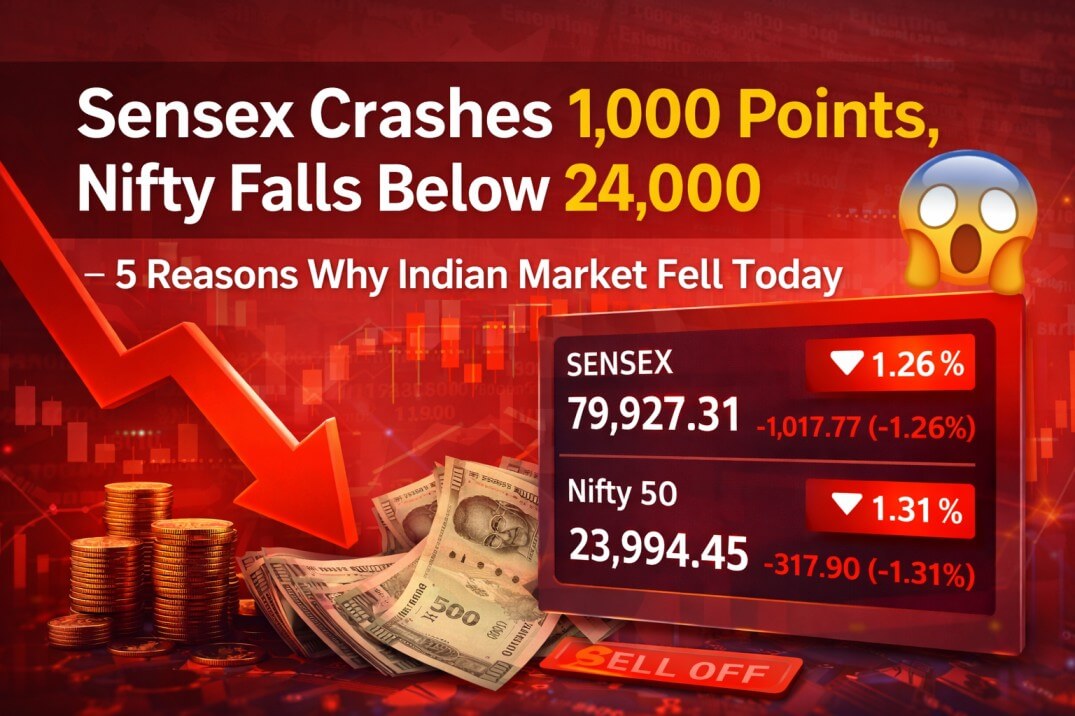
Sensex Crashes 1,000 Points, Nifty Falls Below 24,000 — 5 Reasons Why Indian Market Fell Today
Sensex Crashes Over 1,000 Points, Nifty Below 24,000: What Happened on March 11, 2026?
Indian stock markets had a torrid Wednesday. After a brief one-day recovery on Tuesday, benchmark indices fell sharply, erasing all previous gains and leaving investors shaken. The BSE Sensex plunged more than 1,000 points while Nifty 50 fell below 24,000, signalling cautious sentiment across the market. Kotak Neo
Here is a complete breakdown of what happened, why it happened, and what investors should watch next.
What Happened on March 11?
The BSE Sensex opened flat at 78,238.91 and briefly hit a high of 78,324.37 in early trade before drifting lower as the session progressed, eventually cracking more than 900 points or 1.1% to trade around 72,292 by mid-session. Enrich Money
The Nifty 50 opened at 24,231.65, hit a high of 24,299, before paring all gains to trade at 24,013 — down 247 points or 1.02% — and briefly slipped below 24,000 to make a low of 23,986. Enrich Money
5 Key Reasons Behind Today's Crash
1. West Asia War & Geopolitical Tensions
The ongoing conflict between Iran and the combined forces of the United States and Israel has created deep uncertainty in global markets. Nifty 50 has dropped nearly 5% since the US-Iran war began. Kotak Neo Risk-off sentiment pushed investors to dump equities and move toward gold and bonds.
2. FII Selling — Foreign Investors Exit India
Foreign investors sold nearly ₹4,700 crore worth of shares on Tuesday alone, even as domestic institutional investors tried to absorb the selling by buying more. Investing.com This selling happened in just six trading sessions in March, and sustained FII outflows are putting pressure on large-cap stocks where foreign funds hold significant positions. Kotak Neo
3. Banking Stocks Led the Collapse
Nifty Auto was the top sectoral loser, dropping nearly 2%, followed by Nifty Bank which fell 1.5% with 13 out of 14 constituents in the red. Enrich Money Nifty Bank declined around 1.7% during the session, and several other large-cap companies also dragged benchmarks lower. Kotak Neo
4. Rupee Weakness
The Indian rupee slipped by 17 paise in morning trade. A weaker currency creates uncertainty in equity markets — it can reduce returns for global investors and influence their investment decisions negatively. Kotak Neo
5. Crude Oil Volatility
Although oil prices have eased from recent highs, they remain highly volatile. For India — which imports a large portion of its energy needs — crude oil price movements directly shape investor mood, as rising costs can affect corporate profitability and economic growth. Kotak Neo
Market Reaction & Expert View
India VIX, the market fear gauge, spiked nearly 9% to go past 20, indicating elevated uncertainty among traders and investors. Enrich Money
Rupak De, senior technical analyst at LKP Securities, noted that the 24,300–24,350 range is acting as a strong resistance zone where sellers are re-entering. He added that the sell-on-rise scenario is likely to persist, with immediate support at 24,150 — and a break below that could trigger further selling toward 23,800. Enrich Money
Despite the fall in frontline indices, the broader market showed relative resilience — mid-cap and small-cap stocks actually moved higher, suggesting the selling pressure was concentrated in large-cap heavyweights. Kotak Neo
What Should Investors Do?
Analysts suggest avoiding panic selling. The DII buying cushion remains intact and India's macroeconomic fundamentals — GST collections, domestic consumption, and capex — remain supportive.
However, with VIX above 20, the market is expected to remain volatile in the near term. Investors should keep a close watch on:
Iran conflict updates and crude oil direction
US CPI data (released overnight)
FII/DII provisional data released after market hours
GIFT Nifty pre-market levels tomorrow morning
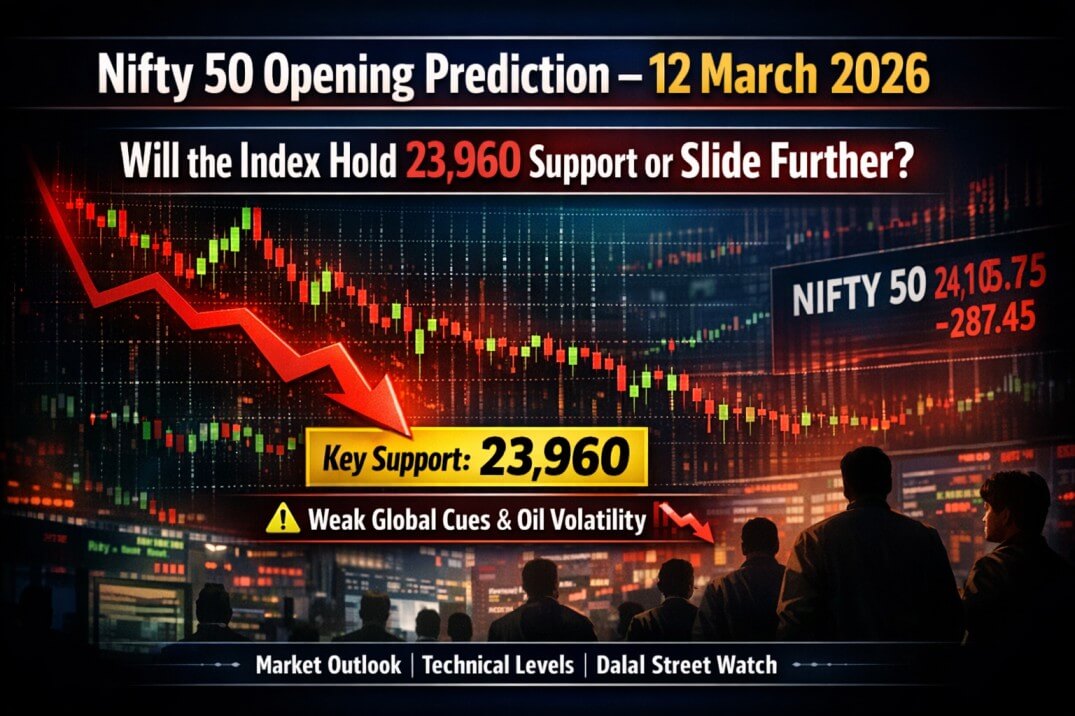
Outlook for March 12, 2026
With Thursday's weekly options expiry approaching and Nifty now trading below 24,000, the key level to watch is 23,800 — the major Put OI wall. If this holds, a relief bounce toward 24,000–24,100 is possible. If it breaks, 23,500 becomes the next major support zone.
Disclaimer: This article is for informational purposes only and does not constitute investment advice. Please consult a SEBI-registered financial advisor before making any trading or investment decisions.